Part I · The Two Names

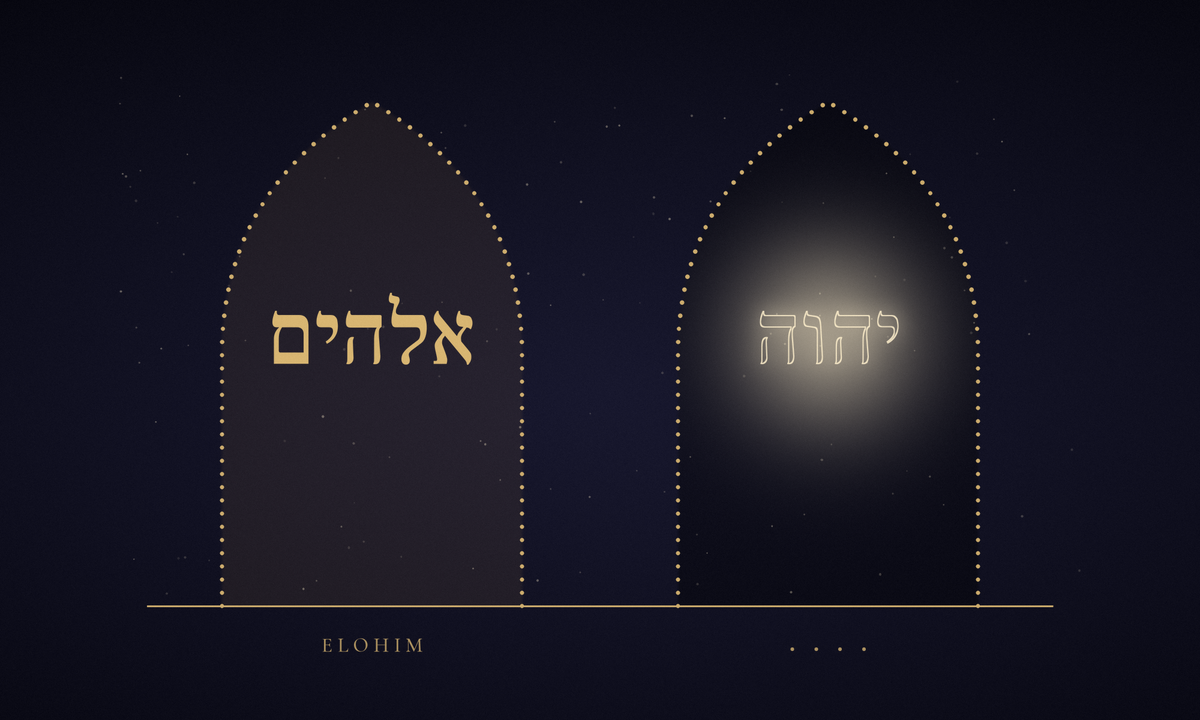
Elohim and YHVH: an essay in seven parts. Part I of VII.
Genesis opens with one name for God and then, a page later, with another. Everything here follows from that, and from the fact that the text keeps doing it: two names, used across whole passages rather than scattered verses, attached to different kinds of divine behaviour, and finally made the subject of an explanation by the text itself.
Most readers pass over it. I could not, and the reason is the work I do. In our tradition a name is not a label but an instrument. We do not merely read names; we use them, and we are taught that a name placed correctly does something that the same name placed elsewhere does not. So when the founding text uses two names for one God, alternates them with evident care, and then halts the narrative to account for the change, I take that as telling us something about how the divine acts, rather than as an accident of scribal history. That conviction is what this essay tests.
What I found went further than I expected, and in one respect against what I had assumed. The doubling is older and stranger than the familiar pair of Genesis 1 and Genesis 2. There is a second creation account in the tradition, carried in the poetry and enacted at the sea, and it belongs to the name YHVH as plainly as the seven days belong to Elohim. The two are not two moods of one God. They are two ways of making: one by speech and separation, the other by division and the conquest of the waters. And both end in the same place, with God taking up residence in what has been made. That alone has changed how I read the opening of Genesis.
The second finding is the one that matters most to me as a practitioner. When the Kabbalists went looking for the Name they could actually work with, they did not take it from the first chapter of Genesis. They took it from three verses at the edge of the sea, in the middle of the second creation. Our operative tradition is quarried out of the account that is usually overlooked. If that is right, then our practice of names is not an inherited technique standing loose from any doctrine. It is continuous with a particular understanding of how God acts, and a magician who does not know which account he is standing in does not know what he is imitating.
One principle governs the whole. I have kept the layers apart and dated them. What the text says, what historians reconstruct about the cults behind it, what the rabbis took the names to mean, and what later Kabbalah built on that reading are four different kinds of claim, separated by centuries. Elohim as judgement is rabbinic and early. Elohim as the name of a sefirah on a particular column is medieval. The shattering of the vessels is sixteenth-century. A question about Genesis cannot be settled by what a name means on the Tree, however much the Tree may illuminate it afterwards. Where I read beyond the evidence, I say so in the text.
What follows traces the two names through the places they are most revealing: the words themselves, the two scenes in which the name is given, the creation stories that belong to each, the scholarly account of why they alternate, the rabbinic account of what they mean, the origins of the system that inherited them, and the point at which the tradition stops reading the names and begins to use them.
The two names
Elohim, אֱלֹהִים, is not a name. It is the common noun for a deity or power of any rank, formed from the same root as el and eloah, a general Semitic word for a supreme power with cognates in Akkadian, Ugaritic and Aramaic. It is plural in form. When it denotes the God of Israel it ordinarily takes singular verbs, which is why Genesis 1:1 can open with a plural noun and a singular verb without implying many gods.
What matters is the range of things the word can denote. It is used of other deities — Chemosh of Moab, Astarte of Sidon — and of angels, kings and judges. At Exodus 21:6 and 22:8–9 ancient interpreters took it to mean judges or rulers. At 1 Samuel 28:13 the witch of Endor sees elohim rising from the earth, and there the verb is plural. Psalm 82:1 uses it twice in one verse, once for God and once for the assembly he stands among. The older textbooks call the plural a pluralis majestatis, a plural of majesty, but that explanation has been challenged as anachronistic and foreign to the Hebrew worldview, and is better read as an intensive or abstract plural, or a relic of older Semitic usage. Either way, Elohim is a category before it is a designation. It says what kind of thing is being spoken of.
YHVH, יהוה, is a name. Four consonants, the Tetragrammaton, written here unpointed as it stands in the consonantal text, connected by Exodus 3 to the verb "to be." It is the most frequent designation in the Hebrew Bible by a wide margin, appearing some 6,800 times against roughly 2,600 for Elohim, with Adonai at about 439 and El at about 238.
And it was taken out of speech. It was not pronounced outside the sanctuary and in time not pronounced at all. The Masoretes marked this by writing the vowels of Adonai over the consonants יהוה, and, where Adonai already stood beside it, the vowels of Elohim instead — producing the ghost-words later misread as Jehovah and Jehovih. This is why English Bibles print "the LORD" in capitals: the capitals mark a name that is present in the text and absent from the reading.
That asymmetry is the root of the whole problem, and it explains why these two carry the weight rather than El Shaddai, Elyon or Adonai, which appear occasionally and organise nothing. A title can be modified and multiplied: Elohim Gibor, Elohim Tzabaoth, El Shaddai, elohim acherim — other gods. A name can do neither. There is no plural of יהוה. Other gods are אֱלֹהִים; no other god is יהוה.
That difference does work in the text. Where the subject is the world, the nations and what is common to all of them, the class word is available. Where the subject is covenant with one people, the name is required. The two are not interchangeable vocabulary for a writer choosing variety, and they do not alternate verse by verse in the manner of poetic parallelism. They alternate across whole passages.
I would add one observation, because the rest of this essay turns on it. The asymmetry runs in a second direction as well. The shareable title stayed sayable, and the exclusive name was withdrawn from speech altogether. A tradition that inherits a Name it may not pronounce has to find some other way of handling it — and that, rather than any doctrine, is the pressure under which the later practice of names grew up.
So the difference between the two is not stylistic. It is the difference between calling something a god and calling it by its name.
The two revelations
The name is revealed to Moses twice, in two scenes that do different work. This is the hinge of the whole question, because it is the one place where the text stops the narrative and accounts for its own use of the names.
Exodus 3, at the burning bush. Moses asks what he should say when the people ask the name of the God who sent him, and he is answered three times over. First, אֶהְיֶה אֲשֶׁר אֶהְיֶה, I will be what I will be. Then: say that אֶהְיֶה has sent me to you. Then the full form — יהוה, the God of your fathers, the God of Abraham, Isaac and Jacob — followed by the declaration that this is my name forever, my remembrance to all generations.
The grammar of that sequence carries the meaning. Ehyeh is the verb "to be" in the first person: the word God uses of himself. The Tetragrammaton is built from the same root in the third person: the word others use of him. Whatever the disputed philology, the text's own gloss is that the name of God is the verb of being, conjugated according to who is speaking. It is the only divine name in the Hebrew Bible that the text bothers to explain, and it explains it as existence itself.
And in the same breath it is taken away. The rabbis noticed that le-olam, "forever," is written in Exodus 3:15 without the letter vav, so that it can equally be read le-alem, to conceal. Rav Nachman bar Yitzchak drew the conclusion that the Name must remain hidden, and that the sages transmit its pronunciation to their students only once in seven years. The same passage reports that Rava intended to expound the pronunciation in a public lecture, and that an elder stopped him with that single word. Rabbi Avina set the two halves of the verse against each other: this is my name, and this is my remembrance — the Name as written and the Name as spoken are not the same thing, and will not be until the world to come.
That is worth dwelling on. The concealment of the Name is not later squeamishness imposed on the text. The tradition finds it in the revelation itself, in the very verse that gives the Name away. What is disclosed and what is withheld arrive together, in one word, written defectively.
Exodus 6. Here nothing is explained. God says: I am יהוה; I appeared to Abraham, Isaac and Jacob as אֵל שַׁדַּי, but by my name יהוה I did not make myself known to them. The opening formula, ani YHVH, is a self-identification rather than an etymology, and it recurs throughout the Priestly material as a refrain. What is asserted is a chronology: an earlier era under one name and a new era under another. And it contradicts Genesis, where Abraham uses the name freely and where, as early as Genesis 4:26, people are said to have begun calling on the name of יהוה in the days of Enosh.
The two scenes are usually assigned to different strands, Exodus 6 to the Priestly material and Exodus 3 to the non-Priestly, and the difference in what they do is consistent with that. One gives the name a meaning; the other gives it a history. The tradition kept both and chose neither, which means that the canonical answer to "what is this name" is two answers: what it signifies, and when it was given.
One further point, which matters for what follows. Both revelations stand at the opening of the exodus. The Name enters human speech at the precise moment when יהוה begins the work of bringing a people out of Egypt through the sea. Elohim has no such scene and needs none, because a title requires no introduction. Only a name has to be given.
Later tradition built on this pair in a way worth noticing. Kabbalah took אֶהְיֶה, the word from the bush, as the divine name of the highest sefirah, and the paired form יהוה אֱלֹהִים of Genesis 2 as the name of the third. I would add that the choice is apt: Ehyeh is the form God uses of himself, prior to the third-person form by which the world names him, which suits a sefirah understood as the least manifest of the ten.
Next week, Part II: The Two Creations — the creation story that belongs to YHVH, and why it is told at the sea.
Sources for this part
- TheTorah.com, "The Revelation of YHWH's Name" — Exodus 3 and Exodus 6